


Connecting everyone to the world of story

Image Alt

Story Links

  /  News   /  Meet the Author: Fiona Wood

Meet the Author: Fiona Wood

By Mia Macrossan
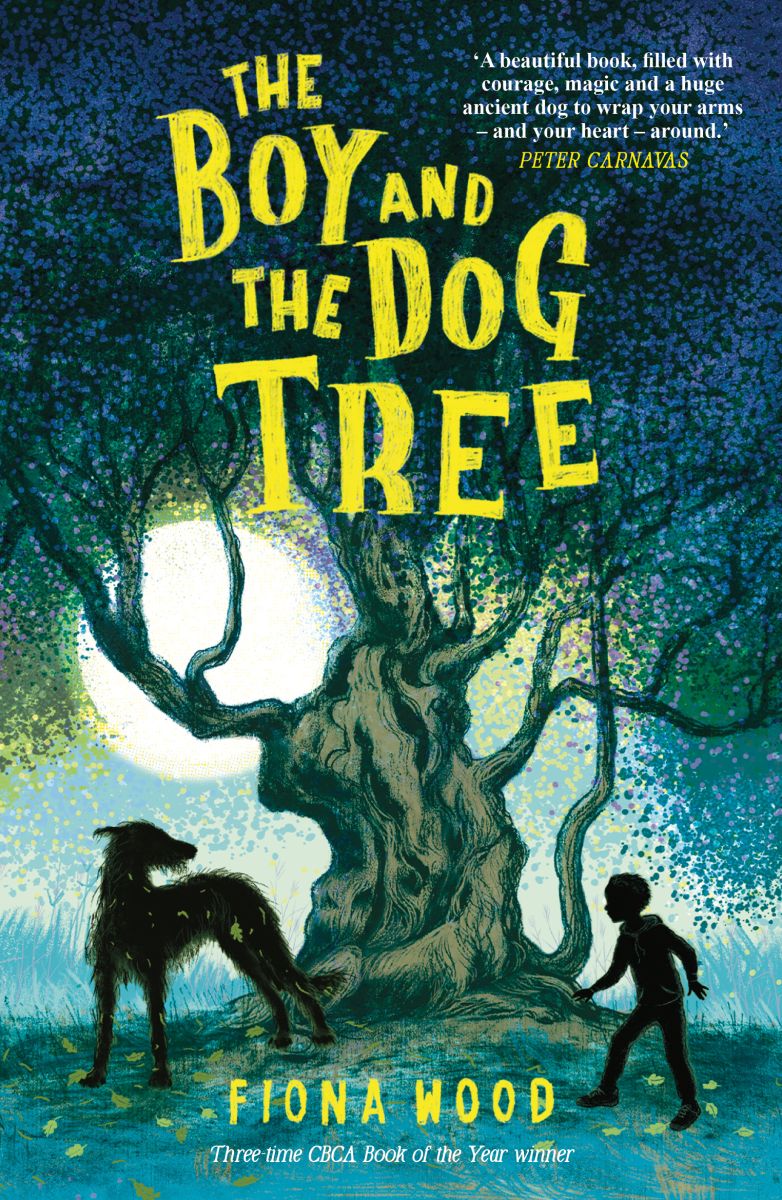
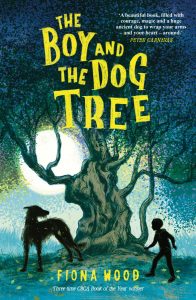
I jumped at the chance to have a chat with Fiona Wood whose books I have enjoyed and admired for many years. (see her website fionawood.com for details). Her latest is The Boy and the Dog Tree, a compelling middle grade novel about a boy who longs for a dog to call his own but he gets Argus, a really special being.
Thank you for talking to StoryLinks, Fiona
You have won many awards for your young adult books and then switched to writing middle grade. The Boy and the Dog Tree is your second mg novel after How to Spell Catastrophe. Why did you switch? Are you happier in this space? Dare I ask is it easier to write a middle grade novel than a young adult novel? ( I think each form has its challenges) Could you explain the differences as you see them?
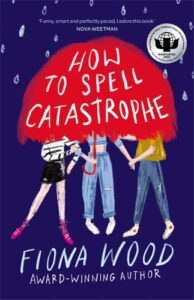
I switched from young adult to middle grade fiction because the book I wanted to write – How to Spell Catastrophe – seemed to sit more comfortably in that readership. One of its themes was climate change and climate anxiety in young people, and I wanted a protagonist who was in that liminal space of middle childhood where understanding of issues is excellent but ability to act is somewhat limited. So it was exciting for Nell, the protagonist, to end up leading her grade six class to School Strike for Climate. Of course, she had other concerns, too, trying to foil her mother’s new relationship and navigating a friendship crisis.
My approach to writing middle grade and young adult fiction is the same in that I try to remember exactly how it felt to be the age of the reader. Once I’m in that headspace, the door opens. There are differing requirements between the two readerships, a shorter word length and more language restrictions for middle grade, for example. For me they are equally challenging to write, and I hope my books give every reader, regardless of age, the same three things: something to think about, something that makes them laugh, something that makes them cry.
The Boy and the Dog Tree has a strong fantasy element while still very grounded in the real here and now. Where did that come from? 
I like magic set within the frame of realism. If the world feels real, a magical event can occur and somehow seem real too. The realism rubs off on the magic. It allows more easily for the suspension of disbelief for me – as a reader and as a writer – than an entirely magical or fantastical world. So it really just comes from that personal preference.
I am never looking at trees the same way ever again. From now on I will be checking to see what powerful creature is possibly lurking inside. Where did the dog/tree combination come from?
An old oak tree I walk past frequently has a particularly gnarled trunk that has always reminded me of a dog. For years I was thinking about how or why a dog might be trapped within a tree. I came up with the idea that the spirit of a dog had been magically bound with the tree, and that the dog could be called forth and embodied when a child needs it. When the child in need climbs the tree their worries are communicated by thoughts, or words, or tears. This triggers the embodiment of the dog.
Then I had to work backwards and ask by whose magic the dog and the tree had been entwined. I decided the dog had been a witch’s familiar; by her powerful magic, she binds dog and tree and confers a magical ability on the dog: he has the power of transformation which can be used for rescue, punishment or reward.
Because I wanted the dog to feel ancient, I had to place his backstory in a time before the first fleet brought oak saplings to Australia, and before city parks were planned and planted. When Mitch asks Argos how long he has been in the tree, he says, For two hundred years and more. The oak you climbed and the one from which it was struck. That gave me the time the backstory required, which readers probably don’t need to know, but I did.
Argos is a such a splendid memorable creation, noble, imposing, not at all a friendly tail wagging dog friend, although that is what Mitch wants. Why?
It’s because Argos came first. The dog in the tree, his backstory, even his voice came before Mitch. So, in plotting a story that began with Argos, I asked myself, who needs this wild companion? Who needs to spend time with this imperious, wilful and even sometimes vengeful creature?
The answer was a quiet boy, a boy who hadn’t quite learnt to speak up for himself, Mitch.
Then if Mitch were someone who had always wanted his own dog and had very clear ideas about what that dog would be like, that gave me potential for humour as well as drama in their friendship, and the ways in which Argos might upend all Mitch’s preconceptions about dogs. It’s a far cry from teaching a pup to shake hands to dissuading Argos from killing Mitch’s nemesis, Seb.
Through the course of their friendship Mitch grows in confidence, and when Argos is imperilled, Mitch finds the will and the strength to be the sort of friend to Argos that Argos has been to him.
Argos talks about need and Mitch is all about want. The whole Argos/Mitch relationship is wonderfully complex. You make the point that Argos is not Mitch’s dog, although Mitch is his boy. I think at one point you say that Mitch is a little afraid of Argos. What are you saying here?
Yes, Mitch’s response to Argos is one of respect, wonder, and ‘awe that was made up of at least fifty per cent fear’. What I’m saying is that Mitch must accept Argos as he finds him, and Argos is terrifying. He will never be tame or obedient; he is the alpha in their friendship. It’s not that Mitch thinks that Argos would ever hurt him, but he knows Argos’s wild appearance and fearless behaviour could attract attention and trouble. And that’s what happens. For example, Seb spreads rumours about a dangerous dog in the park near school. This storyline gives readers the chance to think about rumours, fake news and reliable/unreliable sources of information and how unexamined rumours can lead to prejudice and danger for their subject.
 ‘Mitch was a quiet boy in a loud family’ with a lifelong quest to get a dog– I love this description. Argos certainly has a big impact on Mitch and the whole family. Is there anything autobiographical in this story? Did you want a dog as a child, any pet? Do you think pets, animal companions, are important for children?
Like Mitch, I LONGED for a dog as a child, but I wasn’t allowed one. I do think pets are important and we had a family dog from when my children were little. Looking after a living creature calls for responsibility, patience, kindness and empathy. Dogs are beautiful friends and companions. In fact, as the The Fauves song says, Dogs Are the Best People.
Your novels are always rich in themes delicately explored. Family, friendship and in this one bullying is important. Bullying is a common theme in mg fiction and Seb Anders is a classic of his kind. Why is he here?
Seb is here to heap misery on my protagonist, Mitch. He’s a sly bully who manages to say undermining and threatening things under the radar. And he has enough sway that plenty of his classmates go along with him rather than risk being bullied themselves. Mitch is already sad and discombobulated that the move to Melbourne ends up happening while his parents are overseas, and being picked on by Seb Anders is the last straw. Mitch climbs the dog tree to stew over his worries and unknowingly calls to Argos.
Seb is then the one who creates trouble by spreading rumours. Mitch’s friendship with Argos teaches him that he can stand up to a bully like Seb. I think readers will enjoy Argos’s punishment of Seb.
I don’t think bullying every goes away as a behaviour. We need lots of stories that reflect on bullies and how to cope with being bullied. I am hoping to explore Seb the bully further in the next book, though he won’t be a POV character.
Your stories are written in very short chapters, vivid, fast moving, like scenes in a film. Is this your natural style or the influence of the years as a tv scriptwriter? Is this a conscious decision to suit modern children’s shorter attention span?
I’ve consciously written short chapters for the two middle grade books. I do this hoping to make the book palatable – each chapter a tasty morsel, particularly for younger readers and for anyone who finds reading difficult. My hope for this book is that it’s fun to read, and makes readers want to read another book. Judy Watson’s beautiful illustrations will also enhance the reading experience for this age group.
 Screenwriting has certainly influenced my writing, particularly in the sense of wanting to keep things lean and cut extraneous material. Apologies to editors and friends who have read early drafts containing lots of extraneous material. A lovely TV editor told me gently that in the draft she read of my first book, Six Impossible Things, the story started on page 76.
Final questions: What was/were your favourite book/s as a child?
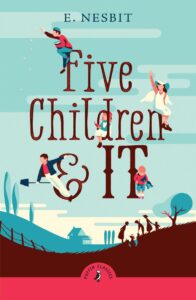
One favourite book from childhood that links through to The Boy and the Dog Tree, is Five Children and It by E. Nesbit. It is an example of magic – the discovery of a wish-granting Psammead – occurring in the children’s ‘real life’.
What are you writing next – mg or ya?
Middle grade again. It’s a story about Dido from The Boy and the Dog Tree, who is a witch but doesn’t know it yet.
And, as it is always fascinating to hear what writers read, what have you enjoyed reading recently?
I’ve loved Endling by Maria Reva, The Rot by Evelyn Araluen and only caught up recently with Laura Elvery’s wonderful Nightingale. I read Sonny & Tess by Nova Weetman last year but picked it up again this morning and couldn’t resist dipping in again. This is one to press into the hands of every 11- and 12-year-old you know. A gorgeous read.
Wow, thank you so much for your generous and considered answers to our questions. It’s been wonderful to gain these extra insights into The Boy and the Dog Tree, which I recommend as a fabulous read to everyone.
Find out more about FIona and her books at fionawood.com
f
1942 Amsterdam Ave NY (212) 862-3680 chapterone@qodeinteractive.com

Error: Contact form not found.

Free shipping
for orders over 50%