
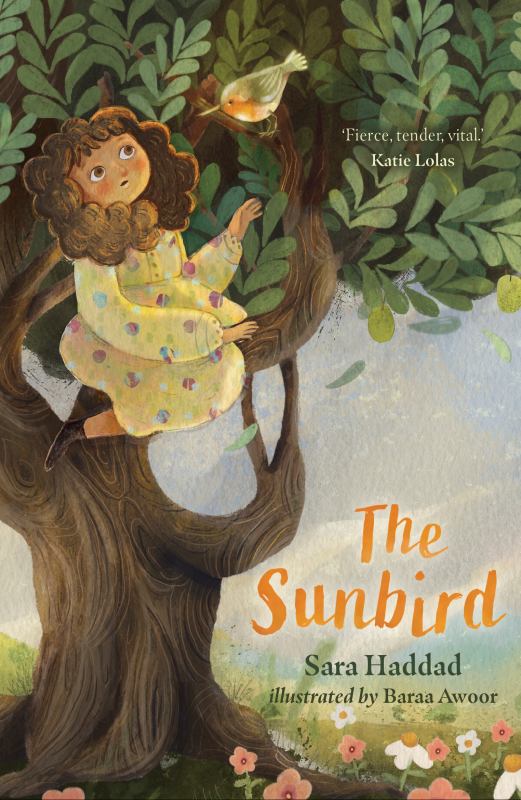
The Sunbird Younger Readers’ Edition
Written by Sara Haddad
Illustrated by Baraa Awoor
Reviewed by Zewlan Moor
I am old
Give me back the stars of childhood
That I may chart the homeward quest
Back with the migrant birds,
Back to your awaiting nest.
Mahmoud Darwish
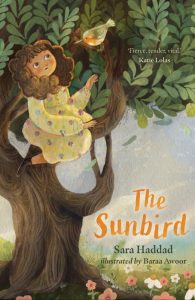 This verse by Palestine’s most famous poet pre-empts the themes of home, migration and return explored within The Sunbird, a junior fiction novel by Sara Haddad. A nest, with the fluttering national birds, is featured on the cover. Black-and-white illustrations by Baraa Awoor, a celebrated Palestinian illustrator recently displaced from Gaza, are “nested” alongside the text. The poem itself is “nested” between the cover and the prologue. And the prologue and last chapter form a nested narrative structure containing the main narrative. The prologue begins in 2025, at a Palestine rally. An old woman called Nabila starts to tell a story to an eager young boy named Zain. “‘Once upon a time, I was a little girl in Palestine, and everything was beautiful …’” (3)
Nabila Yasmeen was “a little girl with knobbly knees and wiry black hair who had been born in the shade of a pomegranate tree” (5-6). The year is 1947, Nabila is five-and-a-half years old, and she is determined to convince the village teacher that she is old enough to attend school. However, when she sneaks to the classroom window, she notices the teacher is distracted and using big words no one can understand. Such as “Resolution 181”, “partition” and “mandates” (14). He tells them that Palestine is to be divided and a new country formed within it. Nabila is confused:
How could a new country be put inside a country that was already there? … Where did it come from? What would happen to the people who were already there? (14-15)
It is not too long before some of Nabila’s questions are answered. In 1948 her village is bombed and she spends three days with another family, before her father finds her. Her family is displaced, first to an olive grove, then to a cave and then to Lebanon. Eventually they move to a foreign land (presumably Australia) full of peculiar animals and a “sun that was even hotter than the one they were used to” (62).
Throughout the story, the imagery and descriptions are evocative and will appeal to children. Especially the descriptions of quiet time with family, and Nabila’s first experience of ice-cream—bright purple, in fact!
In the last chapter the narrative comes full circle, returning to the rally, with the elderly Nabila sharing the story of two precious objects with Zain. One of them is the key to her family home in Palestine, which is widely emblematic of the Nakba experience of so many diasporic Palestinians. It symbolises the ethnic cleansing campaigns that started in the 1940s and continue to the present day. Included in this are themes of home, refugees and the injustice of the original inhabitants not being afforded a right of return to their homeland.
This book is a gentle but vivid story of an important time in history, that gives context to the current Palestinian Genocide* being carried out by the Israeli government. The editorial team of Cathy Vallance, Felicity Dunning and Aviva Tuffield at UQP are to be commended for recognising the need for this book, and for adapting it from the original adult version.
When we think of the many thousands of children’s books published worldwide about the Holocaust and World War Two, including Morris Gleitzman’s Once series and Katrina Nannestad’s historical fiction novels, we must recognise the dearth of similar titles about the Nakba and subsequent Israeli occupation of Palestine.
Similarly, if people say the subject matter is too heavy or depressing for our children, we must remember the preponderance of titles, such as When Hitler Killed Pink Rabbit; I Am David; and The Silver Sword, that have been read and taught in primary and high schools for decades. They have helped to raise empathetic readers who demand that the lessons of the Holocaust, “Never Again”, are heeded for everyone. I hope that The Sunbird will be the first of many stories, from many different perspectives, which counteract the shameful silencing of this part of world history.
For these reasons, and for the gentle child-centredness of the text, I anticipate that this may be the most important children’s book published in Australia this year.
* As defined by the United Nation’s Independent Commission of Inquiry. Chris Gunness, Former UNRWA Chief Spokesperson, “The Palestinian Genocide: The Ultimate Evidence”, Double Down News, 20 January, 2026. Accessed 1 February 2026 on YouTube.
 Zewlan Moor is the author of Nothing Alike, The Bill Dup and Our World: Philippines